The rapid growth of genomic data has created major challenges in biomedical research. With projects generating terabytes of sequencing data, traditional local computing infrastructures are no longer sufficient. Cloud computing has emerged as a powerful solution to handle these large-scale datasets efficiently. In this post, it explores FireCloud, a scalable cloud-based platform for collaborative genome analysis), a cloud-based platform designed to enable collaborative and scalable genome analysis, based on the work by Birger et al. (2017).
What is FireCloud?
FireCloud is a cloud-based platform developed by the Broad Institute as part of the National Cancer Institute (NCI) Cloud Pilots. It is built on a cloud computing infrastructure and provides researchers with tools to store, manage, and analyze large genomic datasets.
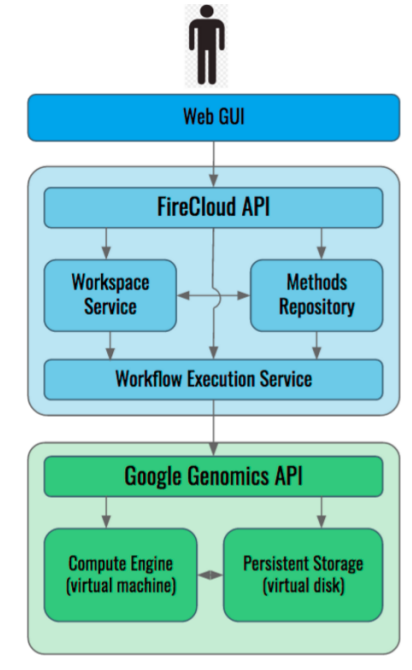
Figure 1: Overview of the FireCloud platform architecture. FireCloud is a collaborative platform for genomic analysis that runs on the Google Cloud Platform. User interfaces are a Web GUI and a RESTful API for programmable access.
The platform integrates:
- Large public datasets such as The Cancer Genome Atlas (TCGA)
- Scalable computing resources
- Reproducible workflows for genomic analysis
Unlike traditional systems, FireCloud allows researchers to perform analyses directly in the cloud without downloading massive datasets locally.
Key Features
1. Scalability and Elastic Computing
FireCloud leverages the elastic nature of cloud computing, allowing users to scale resources depending on the size of their analysis. This is essential for genomics, where datasets can include hundreds of thousands of samples.
2. Collaborative Workspaces
The platform organizes work into workspaces, which act as shared environments containing:
- Data
- Analysis workflows
- Results and history
These workspaces can be shared among researchers, enabling collaboration across institutions.
3. Reproducible Workflows
FireCloud uses workflows defined in the Workflow Description Language (WDL), ensuring that analyses can be reproduced and reused. Each task runs in a Docker container, making the computational environment consistent.
Cost Challenges in the Cloud
One of the most important aspects discussed in the article is the cost model of cloud computing.
Unlike traditional infrastructure (fixed cost), cloud computing follows a pay-as-you-go model. While this provides flexibility, it also introduces uncertainty and the risk of unexpected expenses.
The authors highlight that large-scale analyses can quickly become expensive if resources are not optimized.
Strategies for Cost Optimization
The paper proposes several strategies to reduce costs while maintaining performance:
1. Dynamic Disk Sizing
Instead of allocating fixed storage, disk size is adjusted based on input data, avoiding unnecessary costs.
2. Optimized Virtual Machines
Monitoring tools revealed that some tasks were over-provisioned. By reducing CPU usage to match actual needs, costs were significantly reduced.
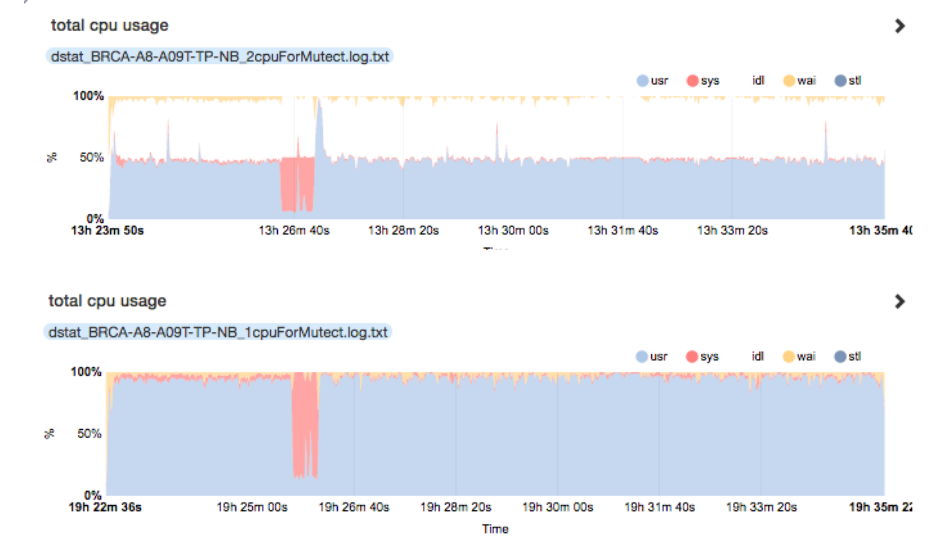 Figure 2: CPU usage before and after optimization.
3. Preemptible Virtual Machines
Cloud providers offer discounted instances (up to ~80% cheaper), which can be terminated at any time. These are useful for short tasks and can greatly reduce costs.
4. Parallelization Strategies
Two main approaches are compared:
- Running tasks across multiple machines (scatter)
- Running multiple processes on a single large machine
Each approach has trade-offs depending on data size and storage costs.
Real-World Application: Cancer Genomics
FireCloud is particularly useful in cancer research, where workflows such as mutation detection require processing large genomic datasets.
For example, analyzing 100 cancer patients can involve:
- Thousands of virtual machines
- Terabytes of storage
- Complex multi-step workflows
Cloud platforms like FireCloud make this type of large-scale analysis feasible and reproducible.
Advantages of FireCloud
- Handles massive genomic datasets efficiently
- Enables collaboration between institutions
- Supports reproducible science
- Scales computational resources on demand
Limitations and Challenges
- Cost estimation is difficult
- Risk of high expenses without optimization
- Requires understanding of cloud infrastructure
- Data transfer (especially downloading) can be expensive
Conclusion
FireCloud represents a major step forward in biomedical data analysis. By leveraging cloud computing, it enables researchers to process large-scale genomic data, collaborate globally, and perform reproducible analyses.
However, as highlighted in the article, careful cost management is essential to fully benefit from cloud-based systems. As cloud technologies continue to evolve, platforms like FireCloud are likely to play a central role in the future of precision medicine and cancer research.
References
Birger, C., Hanna, M., Salinas, E., et al. (2017).
FireCloud, a scalable cloud-based platform for collaborative genome analysis: Strategies for reducing and controlling costs.
bioRxiv. https://doi.org/10.1101/209494